Banex Blog
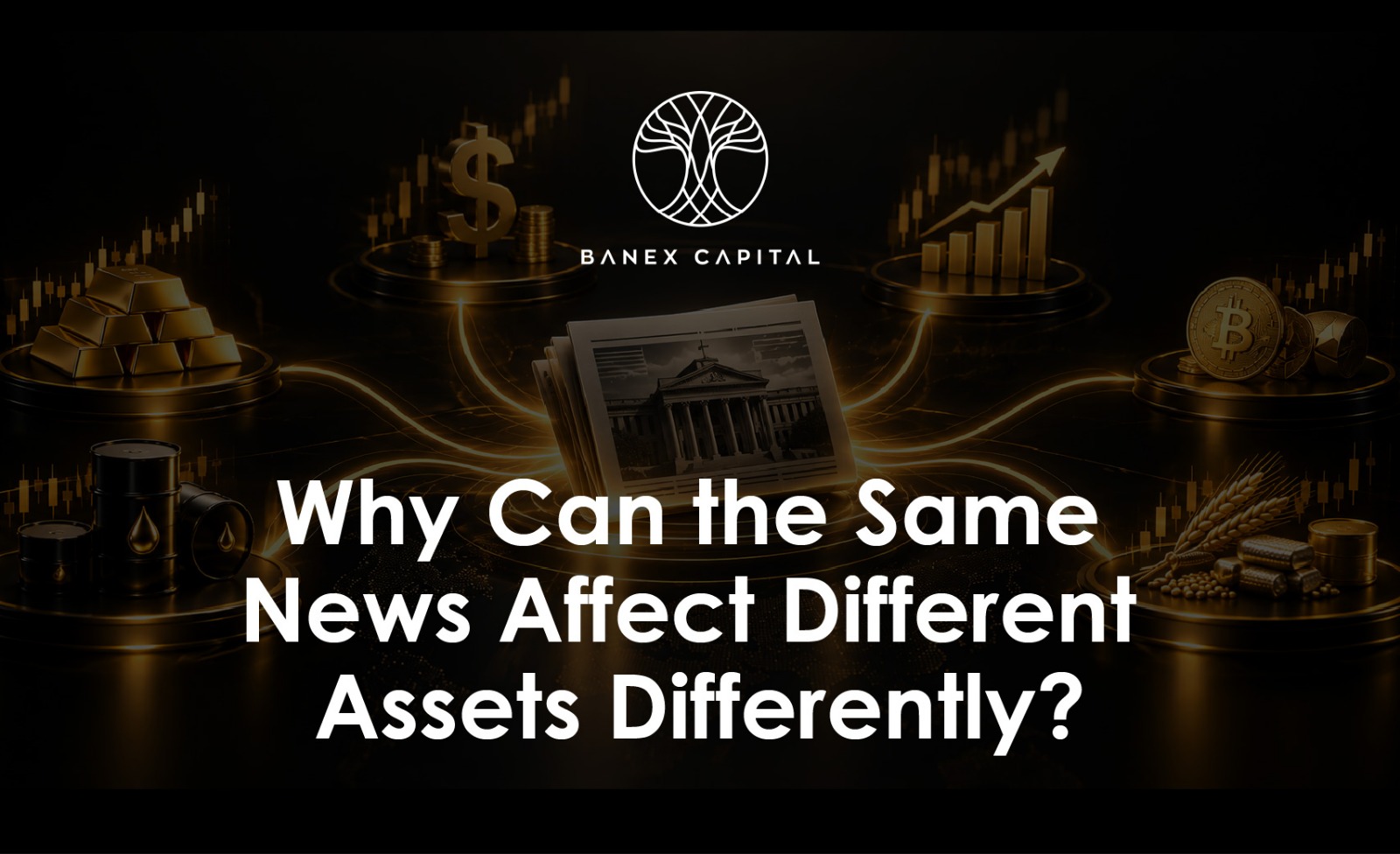
Why Can the Same News Affect Different Assets Differently?
A major economic announcement can send one market higher while another moves lower. Sometimes, two assets react in the same direction but with very different intensity.
Why does this happen?
Financial markets are interconnected, but different assets respond to news based on their own characteristics, market drivers, and the expectations already priced into them. The same economic development can therefore create different reactions across currencies, commodities, indices, and cryptocurrencies.
Understanding this relationship can help provide a broader perspective when analysing financial markets.
Why Doesn’t All News Affect Assets the Same Way?
The simple answer is that different assets have different drivers.
A currency may react primarily to interest-rate expectations, while crude oil may respond more strongly to changes in supply and demand. Gold can be sensitive to interest rates, the US dollar, and market uncertainty, while an index may react to expectations around corporate earnings and economic growth.
So, when a major piece of news is released, the market reaction depends on which factors are most relevant to each asset.
Another important factor is expectations.
Markets do not only react to what happens. They also react to whether an event was different from what investors and market participants expected.
1. Interest Rate Decisions
Consider a central bank announcing an interest-rate decision.
For currency markets, interest rates can be particularly important because changes in rates can influence the relative attractiveness of holding one currency compared with another.
But the same decision can affect other markets differently.
Higher interest rates may influence equity markets by changing borrowing costs and expectations around economic growth. Gold can also respond to changing interest-rate expectations because interest-bearing assets can become relatively more attractive when yields rise.
The actual reaction, however, depends on what the market had already anticipated.
2. Inflation Data
Inflation is another example of news that can have broad but different effects.
Higher-than-expected inflation may lead markets to reassess expectations around future interest-rate decisions. That can influence currencies, bonds, indices, and precious metals.
However, the impact on each asset may differ. A currency could respond to expectations of tighter monetary policy, while an equity index could react to concerns about higher borrowing costs or business expenses.
The same inflation figure can therefore produce different market responses depending on the asset being analysed.
3. Economic Growth
Economic growth data can also influence multiple markets.
Stronger-than-expected economic growth may support expectations of increased business activity and demand. This can influence equity markets and potentially affect currencies.
For commodities, however, the implications may depend on what type of economic activity is involved.
4. Geopolitical Events
Geopolitical developments provide another clear example.
A conflict or supply disruption involving a major oil-producing region can create concerns about energy supply, potentially affecting crude oil prices. At the same time, uncertainty can influence investor sentiment and increase attention toward assets such as gold.
Currencies can also respond depending on the countries involved and how the event changes expectations around economic growth, inflation, or monetary policy.
The same headline can therefore create different reactions because each market is responding to a different underlying concern.
5. The Role of Market Expectations
One of the most important concepts to understand is that markets react to surprises, not simply headlines.
Suppose economic data is released exactly as expected. The market may show a relatively limited reaction because the information has already been reflected in prices. But if the actual figure is significantly different from expectations, the response can be much stronger.
This is why two seemingly similar news events can produce very different price movements.
The question is not only:
“What happened?”
It is also:
“What did the market expect to happen?”
One Event, Multiple Market Reactions
Imagine a central bank unexpectedly signals that interest rates may remain higher for longer.
The potential chain of reactions could look different across markets:
Currency markets: Expectations around interest rates may influence currency demand.
Gold: Changing expectations around interest rates and yields may affect the appeal of non-yielding assets.
Indices: Higher borrowing costs and changing growth expectations may influence equity sentiment.
Oil: The impact may depend more heavily on how the announcement changes expectations for economic growth and future energy demand.
The event is the same, but the market mechanism is different.
This is why looking at one asset in isolation can sometimes provide an incomplete picture of a major economic development.
Why Context Matters in Market Analysis
News is only one part of the picture.
The market reaction can depend on:
- The nature of the news
- Market expectations
- Economic conditions
- Interest-rate expectations
- Supply and demand
- Market sentiment
- Existing price trends
- The asset’s individual characteristics
This is why the same headline should not automatically lead to the same conclusion across every market.
Understanding why an asset reacts is often more valuable than simply observing how it moved.
Multi-Asset Analysis with Banex Capital
With Banex Capital, traders can explore a broad range of instruments across currencies, metals, energies, indices, and cryptocurrencies through one trading environment.
Instead of analysing a major economic event through the lens of only one market, traders can observe how different assets respond.
Summary
Financial markets are interconnected, but they are not identical.
The same economic announcement, geopolitical development, or market event can affect currencies, commodities, indices, metals, and cryptocurrencies differently because each asset has its own drivers and sensitivities.
Market expectations also play a major role. Prices can respond more strongly when an outcome differs from what participants had anticipated.
For traders, understanding these relationships can provide a broader approach to market analysis. With access to 400+ instruments across multiple markets, Banex Capital provides an environment where traders can explore different asset classes and observe how global developments translate into market movements.
Ultimately, the headline may be the same, but the market story can be different for every asset.
Disclaimer: Trading leveraged financial instruments involves significant risk. Market prices can be volatile and unpredictable. The examples discussed are for educational purposes only and do not represent guaranteed market outcomes or investment ad
Risk disclaimer: This content is for educational purposes only and does not constitute financial advice. Trading forex and CFDs involves significant risk of loss.
Try Demo AccountOpen Live Account